




Mobile commerce (M-Commerce) has transformed the way consumers shop, pay, and interact with businesses. With smartphones becoming an essential part of daily life, customers now expect fast, secure, and seamless shopping experiences from anywhere at any time. As technology continues to evolve, M-Commerce is set to become even more innovative with advancements in Artificial Intelligence (AI), Augmented Reality (AR), voice commerce, digital wallets, and 5G connectivity.
Businesses that embrace the latest M-Commerce trends can improve customer engagement, increase sales, and stay ahead in an increasingly competitive digital marketplace. In this blog, we’ll explore the future trends shaping mobile commerce and how businesses can leverage them for sustainable growth.
What is Mobile Commerce (M-Commerce)?
Mobile Commerce, commonly known as M-Commerce, refers to buying and selling products or services through mobile devices such as smartphones and tablets. It includes activities like online shopping, mobile banking, digital payments, ticket booking, food delivery, and mobile wallet transactions.
Unlike traditional e-commerce, M-Commerce focuses on delivering a user-friendly experience optimized specifically for mobile users.
Why M-Commerce is Growing Rapidly
The widespread adoption of smartphones, faster internet connectivity, secure payment gateways, and user-friendly shopping apps have accelerated the growth of mobile commerce. Consumers appreciate the convenience of shopping anytime, personalized recommendations, quick payment options, and real-time order tracking. Businesses are also investing in mobile-first strategies to meet changing customer expectations and improve conversion rates.
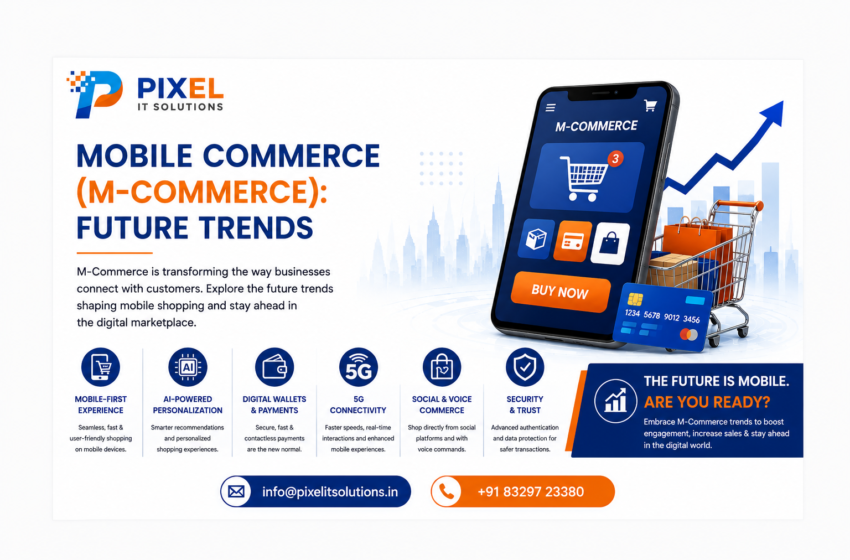
- AI-Powered Personalized Shopping Experiences
Artificial Intelligence is revolutionizing M-Commerce by delivering highly personalized shopping experiences. AI analyzes customer behavior, browsing history, purchase patterns, and preferences to recommend relevant products and offers. Personalized recommendations improve customer satisfaction, increase engagement, and encourage repeat purchases. AI-powered chatbots and virtual shopping assistants also provide instant customer support, making mobile shopping more efficient and interactive. - Voice Commerce Will Continue to Rise
Voice search is becoming an integral part of mobile commerce as more consumers use voice assistants like Google Assistant, Siri, and Alexa to search for products, compare prices, and place orders. Businesses that optimize their mobile applications and websites for voice search will be better positioned to capture this growing audience. Conversational search optimization and natural language content will play a vital role in future M-Commerce strategies. - Augmented Reality (AR) Shopping Experiences
Augmented Reality allows customers to visualize products before making a purchase. Whether trying on clothes virtually, placing furniture in a room, or previewing home décor items, AR enhances buyer confidence and reduces product returns. As smartphone capabilities improve, AR integration will become a standard feature in many mobile commerce applications, offering more immersive shopping experiences. - Digital Wallets and Contactless Payments
The popularity of digital wallets and contactless payment methods continues to grow. Consumers prefer fast, secure, and hassle-free payment options through platforms such as Google Pay, Apple Pay, and other digital payment solutions. Businesses that integrate multiple payment methods into their mobile apps can improve customer convenience, reduce cart abandonment, and increase successful transactions. - 5G Technology Will Enhance Mobile Shopping
The expansion of 5G networks is expected to significantly improve mobile commerce by offering faster internet speeds, lower latency, and smoother app performance. Customers will experience quicker page loading, seamless video shopping, real-time interactions, and high-quality AR experiences. Businesses can leverage 5G to deliver richer content and more engaging mobile shopping journeys. - Social Commerce Integration
Social media platforms are increasingly becoming shopping destinations. Features like in-app product catalogs, live shopping events, influencer collaborations, and one-click purchasing are driving mobile commerce growth. Businesses can connect with customers where they spend the most time and simplify the buying journey through integrated social commerce experiences. - Progressive Web Apps (PWAs)
Progressive Web Apps combine the best features of websites and mobile applications. PWAs load quickly, work offline, send push notifications, and provide app-like experiences without requiring users to download a native application. Many businesses are adopting PWAs to improve accessibility, reduce development costs, and increase user engagement across devices. - Mobile Security Will Become Even More Important
As mobile transactions increase, businesses must prioritize data security and customer privacy. Advanced authentication methods such as biometric verification, facial recognition, fingerprint scanning, and AI-powered fraud detection help protect sensitive information. Investing in robust mobile security builds customer trust and ensures compliance with evolving data protection regulations. - Hyper-Personalization Through Data Analytics
Future M-Commerce platforms will rely heavily on real-time data analytics to create hyper-personalized customer experiences. Businesses can use customer insights to deliver customized product recommendations, targeted promotions, personalized notifications, and dynamic pricing strategies. Data-driven personalization helps improve customer retention and increase lifetime value. - Omnichannel Mobile Commerce
Customers expect a consistent shopping experience across mobile apps, websites, physical stores, and social media platforms. Omnichannel M-Commerce integrates all customer touchpoints into a seamless experience, allowing users to browse, purchase, and receive support across multiple channels. Businesses that adopt omnichannel strategies can improve customer satisfaction, brand loyalty, and long-term growth.
Best Practices for M-Commerce Success
To stay competitive in the evolving mobile commerce landscape, businesses should:
Develop mobile-first applications.
Optimize website speed and responsiveness.
Integrate secure payment gateways.
Use AI for personalization.
Implement voice search optimization.
Invest in robust cybersecurity.
Simplify the checkout process.
Enable push notifications responsibly.
Monitor customer behavior through analytics.
Continuously update mobile app features.
Why Choose Pixel IT Solutions for M-Commerce Development?
Pixel IT Solutions specializes in developing secure, scalable, and feature-rich mobile commerce solutions that help businesses thrive in the digital economy. Our team designs user-friendly mobile applications and responsive e-commerce platforms with advanced features such as AI integration, secure payment gateways, real-time analytics, cloud connectivity, and seamless user experiences. Whether you’re launching a new M-Commerce platform or upgrading an existing one, we deliver customized solutions that improve customer engagement, drive conversions, and support long-term business growth.
Conclusion
Mobile commerce is rapidly evolving with innovations like AI, voice search, AR, digital wallets, 5G, and omnichannel experiences. Businesses that embrace these trends today will be better prepared for the future of online shopping. By investing in modern M-Commerce solutions, companies can enhance customer experiences, improve operational efficiency, and remain competitive in an increasingly mobile-first world. Partnering with experienced developers like Pixel IT Solutions ensures your business is equipped with future-ready mobile commerce technologies that drive sustainable growth.
Build Future-Ready M-Commerce Solutions with Pixel IT Solutions
Take your business to the next level with innovative mobile commerce solutions from Pixel IT Solutions. We design and develop secure, scalable, and user-friendly M-Commerce applications that deliver exceptional shopping experiences and drive business growth. From AI-powered personalization and payment gateway integration to responsive design and ongoing support, our team helps you stay ahead of the latest mobile commerce trends.
Contact Pixel IT Solutions today to build a powerful M-Commerce platform that keeps your business competitive in the mobile-first era.
Company Name: Pixel IT Solutions
Website: https://pixelitsolutions.in/
Phone: +91 832-972-3380
Frequently Asked Questions (FAQs)
- What is Mobile Commerce (M-Commerce)?
Mobile Commerce (M-Commerce) refers to buying and selling products or services through smartphones and tablets using mobile apps or mobile-friendly websites. - How is M-Commerce different from E-Commerce?
E-Commerce includes online transactions on all devices, while M-Commerce specifically focuses on shopping and transactions conducted through mobile devices. - Why is M-Commerce important for businesses?
M-Commerce helps businesses reach mobile users, improve customer engagement, increase sales, provide convenient shopping experiences, and enhance brand loyalty. - What technologies are shaping the future of M-Commerce?
Artificial Intelligence (AI), Augmented Reality (AR), Voice Commerce, 5G, Digital Wallets, Progressive Web Apps (PWAs), and advanced mobile security are driving the future of M-Commerce. - How can businesses improve their M-Commerce strategy?
Businesses should invest in mobile-first app development, optimize website performance, integrate secure payment options, personalize user experiences, and provide seamless omnichannel shopping. - Does Pixel IT Solutions offer M-Commerce development services?
Yes. Pixel IT Solutions provides custom M-Commerce app development, e-commerce website development, UI/UX design, payment gateway integration, cloud solutions, and ongoing maintenance tailored to business needs.