






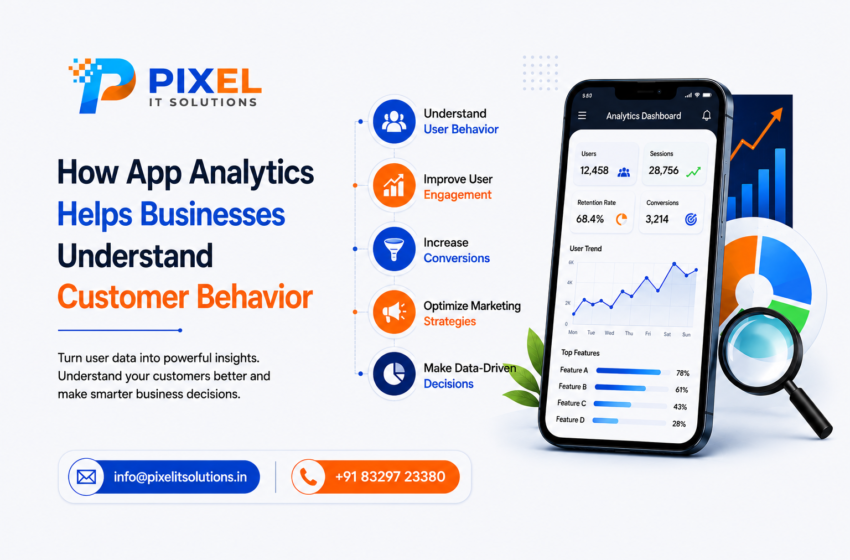
Mobile applications have become an important channel for businesses to connect with customers, provide services, and generate revenue. However, simply having an app is not enough. Businesses need to understand how users interact with their applications, what features they prefer, where they face difficulties, and what encourages them to return. This is where app analytics becomes valuable.
App analytics allows businesses to collect and analyze user interaction data. Instead of relying only on assumptions, businesses can use real data to understand customer behavior and make informed decisions about their mobile app, marketing campaigns, and overall customer experience.
What Is App Analytics?
App analytics refers to the process of collecting, measuring, and analyzing data generated by users while interacting with a mobile application. This data can include app downloads, user sessions, feature usage, screen views, conversions, retention, engagement, and other user activities.
By analyzing these insights, businesses can understand what users are doing inside the app and identify opportunities to improve the overall experience.
Why Is Understanding Customer Behavior Important?
Every customer interacts with an app differently. Some users may frequently use specific features, while others may install the application but stop using it after a few days. Without analytics, identifying these patterns can be difficult.
Understanding customer behavior helps businesses determine which features are valuable, where users are dropping off, what content attracts attention, and which actions contribute to conversions. These insights can help companies make better product and marketing decisions.
How App Analytics Helps Businesses Understand Customers
- Identifies the Most Used Features
App analytics can show which features users interact with most frequently. This helps businesses understand what customers find valuable.
For example, if users regularly use a particular booking, search, payment, or communication feature, the business can prioritize improvements to that functionality. - Shows Where Users Drop Off
One of the most useful insights from app analytics is identifying where users stop their journey.
Businesses can analyze different stages of the customer journey and determine whether users leave during registration, product browsing, checkout, payment, or another step.
Finding these drop-off points allows businesses to investigate potential usability problems and improve the user journey. - Measures User Engagement
Analytics can help businesses understand how frequently users open an application, how long they spend using it, and how often they return.
Engagement data provides valuable information about whether the app is delivering ongoing value to customers. - Helps Understand User Retention
Downloads alone do not indicate whether an app is successful. Retention data shows how many users continue using the application after installation.
Businesses can compare retention across different user groups and time periods to identify patterns and determine which strategies encourage users to return. - Supports Customer Segmentation
App analytics can help businesses group users based on behavior. For example, users can be segmented according to activity levels, features used, purchase behavior, location, or engagement patterns.
These segments can then be used to create more relevant experiences and marketing campaigns. - Improves Personalization
Behavioral insights can help businesses provide more personalized experiences. If a user frequently interacts with a specific category or feature, the application can potentially highlight relevant content, products, services, or recommendations.
Personalization can make an app more useful and relevant to individual users. - Measures Marketing Campaign Performance
App analytics can help businesses understand what happens after users arrive through advertising campaigns, social media, search, email, or other channels.
By connecting acquisition sources with in-app actions, businesses can identify which marketing channels bring users who are more likely to engage or convert. - Helps Improve the User Experience
Analytics can reveal patterns that may not be obvious from customer feedback alone. If users repeatedly abandon a particular screen or rarely interact with a feature, it may indicate that the experience needs improvement.
Businesses can use these insights alongside usability testing and customer feedback to make better UX decisions.
Important App Analytics Metrics Businesses Should Track
Different businesses require different metrics, but several measurements can provide a useful overview of app performance.
Active Users: Shows how many people actively use the application during a specific period.
Session Duration: Indicates approximately how much time users spend during app sessions.
Retention Rate: Measures how many users continue returning to the app after installation or initial use.
Conversion Rate: Tracks the percentage of users who complete a desired action, such as making a purchase or submitting a form.
Feature Usage: Shows which application features receive the most interaction.
Churn Rate: Helps identify the proportion of users who stop using the application.
Funnel Drop-Off: Shows where users leave during a multi-step journey.
These metrics become much more valuable when businesses analyze them together rather than looking at individual numbers in isolation.
How Businesses Can Use App Analytics Effectively
Collecting data is only the first step. Businesses need to turn analytics into actionable insights.
Start by identifying clear business objectives. For example, a company may want to increase purchases, improve retention, reduce checkout abandonment, or increase feature adoption.
Next, identify the user actions that relate to these goals and track them consistently. Businesses should also regularly review analytics to identify unusual changes, behavioral patterns, and areas for improvement.
Analytics should be combined with customer feedback, usability testing, and business data. Numbers can show what is happening, while customer research can help explain why it is happening.
App Analytics and Data Privacy
Businesses should also treat customer data responsibly. Analytics implementation should follow applicable privacy laws and platform requirements. Users should be informed appropriately about data collection and businesses should avoid collecting unnecessary information.
A responsible analytics strategy balances useful business insights with customer privacy and data security.
Why Choose Pixel IT Solutions for App Development?
Successful app analytics starts with an application that is designed to support measurable user journeys and business goals. Pixel IT Solutions can help businesses develop mobile and digital solutions with user experience, functionality, performance, and scalability in mind.
From planning and development to optimization, the right technology partner can help businesses build applications that provide value to customers while generating useful insights for future improvements.
Conclusion
App analytics gives businesses a clearer understanding of how customers interact with their mobile applications. It can reveal popular features, user drop-off points, engagement patterns, retention trends, conversion behavior, and marketing performance.
The real value of analytics is not simply collecting large amounts of data. It is using those insights to make smarter decisions, improve the customer experience, and continuously optimize the application.
When businesses combine app analytics, customer feedback, UX improvements, and a clear business strategy, they can create mobile experiences that are more relevant, useful, and effective.
Want to Build a Smarter, Data-Driven Mobile App?
Turn customer behavior into actionable insights with a mobile application designed around your business goals. Pixel IT Solutions can help you develop scalable and user-focused mobile solutions that support better customer experiences and business growth.
Get in touch with Pixel IT Solutions today to discuss your app development requirements.
Company Name: Pixel IT Solutions
Website: https://pixelitsolutions.in/
📞: +91 832-972-3380
Frequently Asked Questions
- What is app analytics?
App analytics is the process of collecting and analyzing data about how users interact with a mobile application. It helps businesses understand engagement, retention, feature usage, conversions, and user journeys. - Why is app analytics important for businesses?
App analytics helps businesses make data-driven decisions instead of relying only on assumptions. It can identify user preferences, drop-off points, engagement patterns, and opportunities to improve the application. - Which app analytics metrics should businesses track?
Important metrics can include active users, session duration, retention rate, conversion rate, feature usage, churn rate, and funnel drop-off. The right metrics depend on the app’s goals. - Can app analytics improve customer experience?
Yes. Analytics can identify screens or features where users face difficulties or stop their journey. Businesses can use these insights to improve navigation, functionality, and overall user experience. - Can app analytics help increase app retention?
Yes. By analyzing user behavior and identifying when users stop returning, businesses can find potential issues and develop strategies to improve engagement and retention. - How does app analytics help with marketing?
App analytics can connect marketing sources with user actions inside the application. This helps businesses understand which campaigns and channels attract valuable users. - Is app analytics useful for small businesses?
Yes. Small businesses can use analytics to understand customer behavior, identify high-value features, measure conversions, and prioritize improvements based on actual usage data. - Does app analytics affect user privacy?
Analytics involves collecting user-related data, so businesses should implement it responsibly and follow applicable privacy requirements. Only necessary data should be collected and handled appropriately.