




eCommerce has become an important part of how businesses sell, but not every online store works in the same way. A website built for B2B eCommerce has very different requirements from one designed for B2C eCommerce.
B2C, or Business-to-Consumer, websites are designed to sell products directly to individual customers. B2B, or Business-to-Business, platforms are built for companies purchasing products or services from other companies. While both require secure transactions, intuitive navigation and a reliable shopping experience, their customers, purchasing processes and technical requirements can be significantly different.
Understanding these differences before development begins can help businesses choose the right technology, features and website architecture.
What Is B2B eCommerce?
B2B eCommerce refers to online transactions between businesses. A manufacturer may sell products to distributors, a wholesaler may supply retailers, or a technology company may sell software to corporate customers.
B2B purchasing is often more complex than consumer shopping. Orders can involve large quantities, negotiated pricing, purchase orders, approval processes, credit terms and repeat purchasing.
Therefore, a B2B eCommerce website needs to support more than simply adding products to a cart and completing payment.
What Is B2C eCommerce?
B2C eCommerce involves businesses selling directly to individual consumers.
Examples include online stores selling:
Clothing
Electronics
Beauty products
Furniture
Food
Accessories
Consumer appliances
The primary focus is usually on creating a fast, convenient and visually engaging shopping experience that encourages customers to discover products and complete purchases quickly.
B2B vs B2C eCommerce: The Major Differences
- Target Customers
The first major difference is the type of customer.
B2C websites target individual shoppers, who usually make purchasing decisions themselves.
B2B websites target companies and professional buyers. A single business account may have multiple users, departments and decision-makers.
This difference affects everything from account structure to checkout and pricing. - Pricing Structure
B2C websites generally display a fixed price to every customer, although discounts and promotions may vary.
B2B pricing can be significantly more complicated.
A B2B platform may need to support:
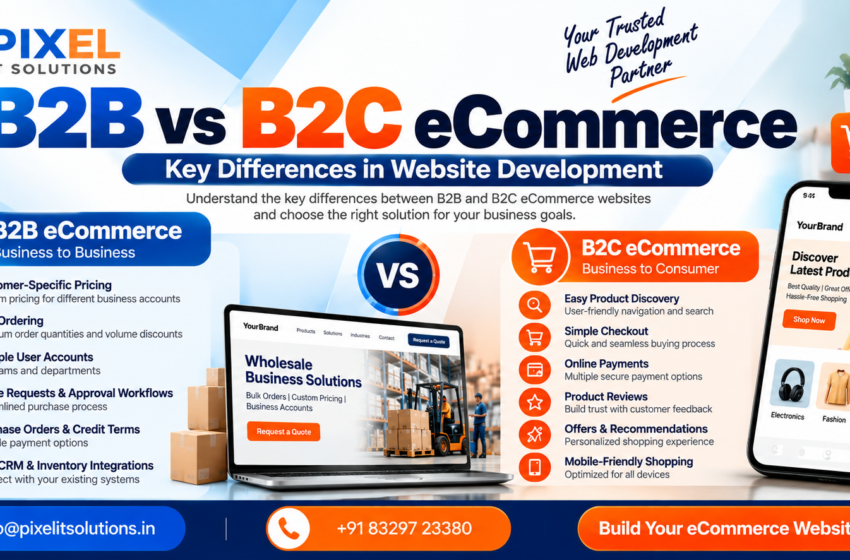
Customer-specific pricing
Bulk pricing
Minimum order quantities
Volume discounts
Negotiated rates
Contract pricing
Dealer pricing
Tiered pricing
The website therefore needs a flexible pricing engine rather than a simple product-price structure. - Product Quantities
B2C customers may purchase one or a few units of a product.
B2B customers may place orders involving hundreds or thousands of units.
This means B2B websites should make bulk ordering simple. Features such as quantity-based discounts, quick order forms, SKU search and bulk product uploads can make the purchasing process much more efficient. - Checkout Process
B2C checkout is generally designed to be as short and frictionless as possible.
Customers may select:
Product → Cart → Address → Payment → Order
B2B purchasing can involve additional steps.
For example:
Product → Quantity → Customer Pricing → Purchase Order → Approval → Credit Terms → Order
Some B2B customers may not even pay online. They may use purchase orders, bank transfers or approved credit accounts.
Therefore, the checkout architecture needs to reflect the company’s actual purchasing workflow. - Customer Accounts
B2C websites typically provide individual customer accounts where users can view orders, addresses, payment methods and wishlists.
B2B platforms often require more advanced account management.
A company account might include:
Multiple users
Different user permissions
Purchasing managers
Finance teams
Administrators
Approval workflows
Department-level access
This makes B2B account architecture more complex. - Product Discovery
B2C customers often discover products through images, categories, recommendations, reviews and promotional campaigns.
B2B buyers are often more focused on specifications, availability, technical documents and product codes.
A B2B website may therefore require:
Advanced product search
SKU search
Technical specifications
Product comparison
Datasheets
Certifications
Downloadable documents
Industry-specific filters
The goal is to help professional buyers find the exact product they need quickly. - Payment Methods
B2C stores commonly support credit cards, debit cards, wallets, UPI and other instant payment options.
B2B businesses may require additional payment methods, such as:
Purchase orders
Bank transfers
Credit accounts
Invoicing
Net payment terms
Customer-specific payment conditions
The website must be capable of handling the payment processes used by the business. - Integration Requirements
B2C eCommerce platforms may integrate with payment gateways, shipping providers, analytics platforms and marketing tools.
B2B platforms often require deeper business-system integration.
These may include:
ERP systems
CRM platforms
Inventory management
Accounting software
Warehouse management
Customer portals
Procurement systems
For larger B2B companies, these integrations can become a critical part of the eCommerce architecture. - Personalization
B2C personalization often focuses on product recommendations and customer behavior.
For example:
“Customers who purchased this product also bought…”
B2B personalization can be account-specific.
A particular company may see:
Its negotiated prices
Previously ordered products
Contract-specific products
Recommended products
Available credit
Reorder options
This makes B2B personalization more closely connected to customer accounts and business relationships. - Mobile Experience
Both B2B and B2C websites need to work well on mobile devices, but the use case can differ.
B2C shoppers may browse and purchase entirely through smartphones.
B2B buyers may use mobile devices to check product availability, reorder products, review quotations or approve purchases while working away from their desks.
Responsive design is therefore important for both models, but the workflows should be designed around the user’s actual business needs.
B2B vs B2C: Which Website Is More Complex?
In most cases, B2B eCommerce development is more complex because it needs to support business-specific workflows.
However, complexity depends on the business model.
A B2C marketplace with thousands of products, multiple sellers, personalized recommendations and complex logistics can also require a highly sophisticated architecture.
The key is not simply choosing between B2B and B2C. It is understanding the actual requirements before selecting the technology and development approach.
Should You Build B2B and B2C Websites Separately?
Not always.
Some businesses sell to both companies and consumers. In such cases, a unified eCommerce platform may be possible.
However, the platform should provide different experiences where necessary.
For example:
B2C customer:
Browse → Add to Cart → Pay → Delivery
B2B customer:
Login → See Contract Price → Select Quantity → Request Quote → Approval → Purchase Order
A well-planned platform can support both workflows while maintaining a common product and inventory system.
Choosing the Right Technology
The technology stack should be selected based on the scale and complexity of the business.
Businesses should consider:
Number of products
Number of customers
Expected traffic
Order volume
Payment requirements
ERP/CRM integrations
Inventory requirements
Security
Scalability
Custom workflows
Future expansion
A simple B2C store may work well with a standard eCommerce platform, while a complex B2B operation may require a highly customized web application.
Why UX Matters in Both B2B and B2C eCommerce
The user experience may be different, but both types of websites need to make purchasing easier.
For B2C, this may mean:
Fast checkout
Attractive product pages
Product recommendations
Reviews
Easy navigation
For B2B, it may mean:
Fast product search
Quick reorder
Account-specific pricing
Bulk ordering
Quote requests
Order history
Approval workflows
The best eCommerce experience is not necessarily the one with the most features. It is the one that makes the customer’s purchasing journey easier.
Final Thoughts
B2B and B2C eCommerce may share the same basic foundation, but their website development requirements can be very different.
B2C platforms generally focus on speed, convenience, product discovery and conversion, while B2B platforms focus more on complex pricing, account management, bulk ordering, purchasing workflows and business-system integration.
Before starting development, businesses should clearly define their customers, purchasing process, pricing model, integrations and future growth plans.
At Pixel IT Solutions, we help businesses plan and develop eCommerce solutions around their specific business requirements—from customer experience and UI/UX to integrations, functionality and scalability.
Planning a B2B or B2C eCommerce Website?
Your eCommerce website should be built around the way your customers actually buy. Whether you need a consumer-focused online store, a sophisticated B2B platform or a solution that supports both, Pixel IT Solutions can help you plan and develop a scalable eCommerce experience.
Talk to Pixel IT Solutions today and turn your eCommerce idea into a powerful digital platform.
Company Name: Pixel IT Solutions
Website: https://pixelitsolutions.in/
Phone: +91 832-972-3380
Email: info@pixelitsolutions.in
FAQs
- What is the main difference between B2B and B2C eCommerce?
B2B eCommerce sells products or services to businesses, while B2C eCommerce sells directly to individual consumers. This difference affects pricing, account management, checkout, ordering and website functionality. - Is B2B eCommerce more difficult to develop than B2C eCommerce?
B2B eCommerce is often more complex because it may require customer-specific pricing, bulk ordering, multiple users, approval workflows, purchase orders and ERP or CRM integrations. - Can one website support both B2B and B2C customers?
Yes. A properly designed eCommerce platform can support both customer types, with different pricing, account features, checkout processes and purchasing workflows. - What features are important for a B2B eCommerce website?
Important features can include customer-specific pricing, bulk ordering, minimum order quantities, quote requests, purchase orders, multiple user accounts, approval workflows, order history and business-system integrations. - What features are important for a B2C eCommerce website?
B2C websites generally need intuitive navigation, attractive product pages, product search, reviews, recommendations, multiple payment options, mobile responsiveness and a simple checkout process. - Does B2B eCommerce need online payment integration?
Not necessarily. B2B businesses may use online payments, but many also rely on purchase orders, bank transfers, invoices or approved credit terms. - How should a business choose between B2B and B2C eCommerce development?
The choice should be based on the target customer, purchasing process, pricing model, order volume, integrations and business objectives. - Can an existing B2C eCommerce website be converted into a B2B platform?
It may be possible, depending on the existing architecture. Additional features such as account-based pricing, bulk ordering, business accounts and approval workflows may need to be developed.