





Introduction
In today’s digital-first world, a company’s website is often the first impression customers have of a business. Whether someone is searching for services, products, or business information, they usually visit a website before making a decision.
A slow, outdated, or poorly designed website can instantly reduce customer trust. On the other hand, a modern and professional website helps businesses build credibility, improve user experience, and increase conversions.
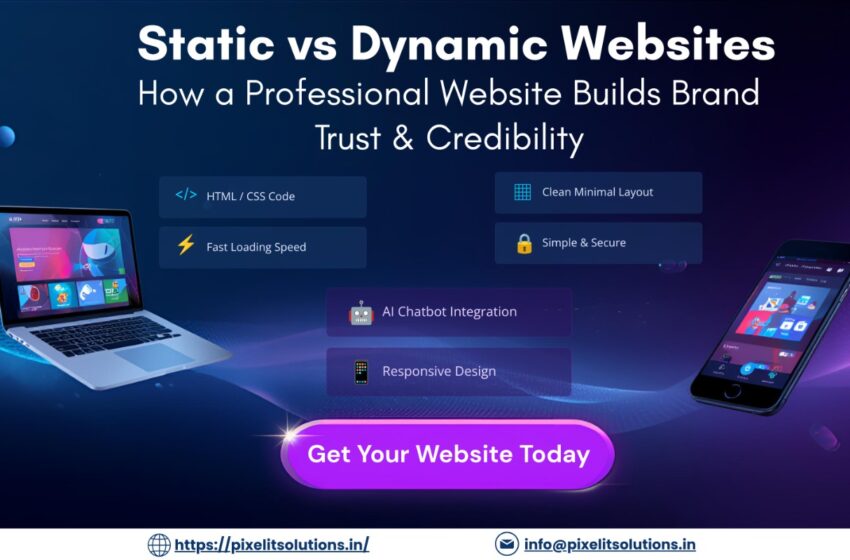
One of the most important decisions businesses make while developing a website is choosing between a static website and a dynamic website.
If you are planning to build or upgrade your business website, this detailed guide by Pixel It Solutions explains the difference between static and dynamic websites, their advantages, and how a professional website strengthens brand trust and online visibility.
Today, a website is not just an online presence—it is a powerful business growth tool.
What is a Static Website?
A static website is a website where the content remains fixed unless manually updated by a developer.
Each webpage is built using:
- HTML
- CSS
- Basic JavaScript
Static websites display the same content to every visitor.
Features of Static Websites
✔ Faster loading speed
✔ Simple website structure
✔ Lower hosting costs
✔ Basic functionality
✔ Easy deployment
Static websites are generally suitable for:
- Small business websites
- Portfolio websites
- Landing pages
- Basic informational websites
Advantages of Static Websites
1. Faster Website Performance
Static websites load quickly because they do not require database processing.
2. Better Security
Since static websites have fewer backend processes, they are less vulnerable to hacking risks.
3. Lower Development Cost
Static websites are more affordable for businesses with simple website requirements.
4. Easy Hosting
They require minimal server resources.
Limitations of Static Websites
Despite their benefits, static websites have limitations:
- Difficult to update frequently
- Limited scalability
- No advanced functionality
- Less interactive user experience
- Not ideal for large businesses
Businesses planning long-term digital growth may eventually require more advanced website capabilities.
What is a Dynamic Website?
A dynamic website displays content dynamically based on user interactions, databases, or backend systems.
Dynamic websites are powered by:
- CMS platforms
- Databases
- Backend programming
- APIs and integrations
Popular dynamic website technologies include:
- WordPress
- PHP
- React
- Node.js
- Laravel
Dynamic websites can automatically update content without rebuilding pages manually.
Features of Dynamic Websites
✔ Interactive functionality
✔ Easy content management
✔ User login systems
✔ Ecommerce capabilities
✔ Advanced SEO optimization
✔ Personalized user experiences
Dynamic websites are ideal for:
- Ecommerce websites
- Corporate websites
- Educational platforms
- Real estate portals
- News websites
- Service-based businesses
Advantages of Dynamic Websites
1. Easy Website Management
Business owners can update:
- Blogs
- Images
- Products
- Services
- Landing pages
without technical coding knowledge.
2. Better User Experience
Dynamic websites allow:
- Interactive interfaces
- Search functionality
- Personalized content
- Live chat systems
- Advanced navigation
This improves customer engagement significantly.
3. SEO-Friendly Structure
Dynamic websites support:
- SEO plugins
- Schema markup
- Dynamic metadata
- Blog management
- Internal linking
This helps improve Google rankings and organic traffic.
4. Scalability for Business Growth
Dynamic websites can easily expand as businesses grow.
You can add:
- Ecommerce features
- Customer portals
- Booking systems
- CRM integrations
- AI chatbots
without rebuilding the website completely.
Static vs Dynamic Websites – Key Differences
| Feature | Static Website | Dynamic Website |
| Content Updates | Manual | Automatic |
| Speed | Faster | Slightly slower |
| Scalability | Limited | Highly scalable |
| User Interaction | Basic | Advanced |
| SEO Flexibility | Limited | Excellent |
| Maintenance | Low | Moderate |
| Best For | Small websites | Growing businesses |
| Database Usage | No | Yes |
| Ecommerce Support | Limited | Full support |
Both website types have their own advantages depending on business goals and requirements.
Why a Professional Website is Important for Businesses
A professional website is one of the strongest trust-building assets for any business.
Customers often judge a business based on:
- Website design
- Loading speed
- Mobile responsiveness
- Content quality
- User experience
An unprofessional website may create doubts about service quality and reliability.
How a Professional Website Builds Brand Trust
1. Creates a Strong First Impression
Your website reflects your brand identity.
A premium website design helps businesses appear:
✔ Reliable
✔ Professional
✔ Established
✔ Customer-focused
First impressions strongly influence customer decisions.
2. Improves Business Credibility
Modern consumers trust businesses with:
- Professional websites
- Secure browsing
- Clear contact information
- Positive user experience
A well-developed website increases customer confidence and authenticity.
3. Enhances User Experience
Professional websites focus on:
- Fast loading speeds
- Mobile responsiveness
- Easy navigation
- Clear layouts
- User-friendly interfaces
This keeps visitors engaged for longer durations.
4. Supports SEO & Online Visibility
SEO-friendly websites rank better on Google.
Professional web development helps improve:
- Technical SEO
- Core Web Vitals
- Mobile optimization
- Page speed
- Structured data
Better rankings lead to higher traffic and more business opportunities.
5. Increases Lead Generation & Conversions
A professionally designed website includes:
- Clear call-to-actions
- Conversion-focused layouts
- Lead capture forms
- Contact integrations
- Sales funnels
This improves enquiry generation and conversion rates.
Why Businesses Prefer Dynamic Websites in 2026
As digital competition increases, businesses need websites that are:
- Flexible
- Scalable
- SEO-friendly
- Conversion-focused
Dynamic websites support modern business needs better than traditional static websites.
Most successful businesses today prefer dynamic websites because they offer:
✔ Better marketing integration
✔ Easier updates
✔ Improved customer engagement
✔ Advanced analytics
✔ Long-term scalability
Essential Features Every Professional Website Should Have
1. Mobile-Friendly Design
Most users browse websites on mobile devices.
2. Fast Loading Speed
Website speed impacts SEO rankings and user experience.
3. SSL Security
Secure websites improve trust and protect user data.
4. SEO Optimization
Helps websites rank on search engines.
5. Easy Navigation
Improves user experience and engagement.
6. Professional UI/UX Design
Modern design improves brand perception.
7. Contact & Lead Forms
Makes customer communication easier.
Pixel It Solutions develops high-performance business websites with all modern web development standards.
Why Businesses Choose Pixel It Solutions for Website Development
Pixel It Solutions provides professional website design and development solutions for startups, local businesses, and growing brands.
Key Advantages
✔ Static & Dynamic Website Development
✔ SEO-Friendly Website Architecture
✔ Mobile Responsive Design
✔ Ecommerce Website Solutions
✔ UI/UX-Focused Development
✔ Conversion-Optimized Layouts
✔ Fast & Secure Websites
Their team focuses on building websites that not only look professional but also generate real business growth.
Results Businesses Can Expect
With a professionally developed website, businesses can achieve:
📈 Better Google rankings
🌐 Increased website traffic
📞 More customer enquiries
💼 Improved brand credibility
🚀 Higher business conversions
💰 Long-term online growth
Conclusion
Choosing between a static and dynamic website depends on your business goals, budget, and future growth plans.
Static websites are suitable for simple online presence requirements, while dynamic websites offer flexibility, scalability, and advanced business functionality.
In today’s competitive digital landscape, a professional website is essential for building trust, improving SEO rankings, and increasing customer conversions.
Businesses that invest in high-quality website development gain a stronger competitive advantage and create lasting customer confidence.
If you are looking to build a professional, SEO-friendly, and high-converting website, Pixel It Solutions offers complete website design and development solutions tailored to your business needs.
🚀 Build a Professional Business Website with Pixel It Solutions
Company Name: Pixel It Solutions
Website: https://pixelitsolutions.in/
Services: Static Website Development, Dynamic Website Development, UI/UX Design, Ecommerce Development, SEO-Friendly Web Design
👉 Contact Pixel It Solutions today and build a website that grows your business online.
FAQ Section
1. What is the difference between static and dynamic websites?
Static websites display fixed content, while dynamic websites update content dynamically using databases and backend systems.
2. Which website is better for SEO?
Dynamic websites generally offer better SEO flexibility and content management features.
3. Are dynamic websites more expensive?
Yes, dynamic websites usually require higher development costs due to advanced functionality.
4. Why is a professional website important for businesses?
A professional website improves brand trust, online visibility, customer engagement, and business credibility.
5. Is mobile responsiveness important for websites?
Yes, mobile-friendly websites improve user experience and Google rankings.
6. Can Pixel It Solutions build SEO-friendly websites?
Yes, Pixel It Solutions develops SEO-optimized, responsive, and conversion-focused websites for businesses.