



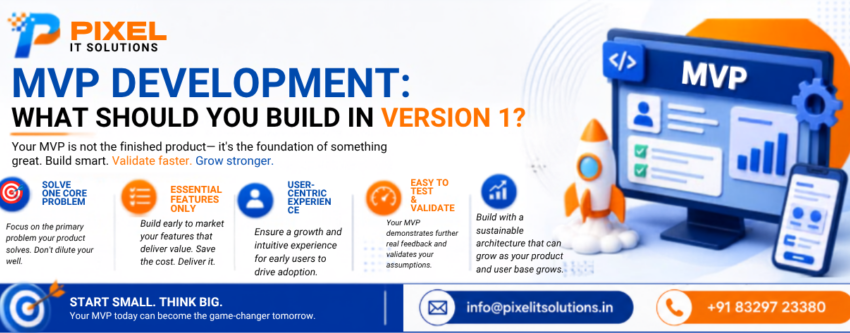
Building a new digital product is exciting, but trying to include every feature from day one can quickly increase development costs, extend timelines and make the product unnecessarily complicated. This is where MVP development becomes important.
A Minimum Viable Product (MVP) is the first functional version of a product that includes only the essential features required to solve a specific customer problem and validate the business idea. The objective is not to build a complete product immediately. Instead, an MVP helps businesses launch faster, collect real user feedback and make informed decisions about future development.
For startups and businesses working with a mobile app development company, defining the right Version 1 can make the difference between a focused product launch and an expensive development cycle.
What Is an MVP?
An MVP, or Minimum Viable Product, is a basic but usable version of a digital product designed to test its core value proposition with real users.
For example, if you want to build a food delivery application, the first version may need:
User registration and login
Restaurant or food listing
Food selection
Cart
Order placement
Online payment
Order status
Advanced features such as loyalty programmes, AI recommendations, subscription plans and sophisticated analytics can be introduced later after understanding user behaviour.
The goal is to answer one fundamental question:
Does the product solve a real problem for its intended users?
Why Should Businesses Build an MVP First?
MVP development allows businesses to validate their idea before making a large investment.
- Launch Faster
A smaller feature set means the development team can focus on the most important functionality and bring the product to market sooner.
A faster launch allows businesses to start collecting real-world feedback instead of spending months developing features based only on assumptions. - Reduce Initial Development Costs
Developing every planned feature at once can require substantial resources. An MVP limits the initial scope and allows businesses to invest in the features that matter most.
This does not mean compromising on quality. It means prioritising functionality. - Test Your Business Idea
Market research can provide useful information, but actual user behaviour provides stronger validation.
An MVP gives businesses an opportunity to understand:
Whether customers use the product
Which features they prefer
Where users face problems
Whether customers are willing to pay
What improvements should be prioritised - Collect Real User Feedback
Users may interact with a product differently from what a business expects.
Launching an MVP provides direct feedback that can guide future product decisions. - Build Based on Evidence
Instead of investing heavily in assumptions, businesses can use real data to decide which features should be developed next.
This creates a more flexible and user-focused product development process.
What Should You Build in Version 1?
The biggest challenge in MVP development is deciding what belongs in Version 1.
A useful approach is to identify the core problem, the primary user, and the minimum functionality required to solve that problem.
Start With the Core Problem
Before listing features, define the problem your product is solving.
Ask:
What problem are customers experiencing?
Who experiences this problem?
How are they solving it today?
Why would they use our product?
What is the simplest way our product can provide value?
Your MVP should be built around the answers.
Identify Your Primary Users
Trying to satisfy every possible customer in Version 1 can make the product unnecessarily complex.
Instead, identify your primary user group and design the MVP around its most important needs.
For example, a business management application may initially focus on small business owners rather than attempting to serve enterprises, freelancers and large organisations simultaneously.
Define the Core User Journey
Map the journey a user needs to complete to receive the primary value of the product.
For example:
Sign Up → Select Service → Book Service → Make Payment → Receive Confirmation
If a feature does not contribute meaningfully to this core journey, consider moving it to a later version.
Prioritise Must-Have Features
Divide potential features into three categories:
Must Have: Essential for the product to work.
Should Have: Useful features that can improve the experience but are not essential.
Could Have: Additional features that can be considered after initial validation.
For an MVP, focus primarily on the Must Have category.
Keep the User Experience Simple
A simple MVP should still provide a good user experience.
Users should be able to understand:
What the product does
How to get started
What action to take next
How to complete the main task
How to get help when needed
A small product with a confusing interface can fail just as easily as a feature-heavy product.
Include Essential Security
Security should not be treated as a future feature.
Even an MVP may handle user accounts, payments, personal information or business data. Basic security measures should therefore be considered during the initial development stage.
Depending on the product, this can include secure authentication, data protection, access controls, secure payment integration and appropriate backup processes.
Features You May Not Need in Version 1
Many businesses make the mistake of adding features because they sound impressive rather than because users need them.
Depending on the product, you may be able to postpone:
Advanced AI features
Complex dashboards
Multiple subscription tiers
Social networking functionality
Extensive customisation
Advanced recommendation engines
Complex integrations
Gamification
Large-scale automation
Multiple user roles
These features can be valuable later, but they may not be necessary for proving the initial product concept.
MVP Does Not Mean Poor Quality
One common misconception is that an MVP should be a poorly designed or unfinished product.
That is not the purpose of an MVP.
An MVP should have a limited scope but reliable execution.
The product should perform its primary function properly, provide a reasonable user experience and allow the business to learn from real users.
Think of an MVP as a focused product—not a broken product.
How to Prioritise Features for Your MVP
A simple feature prioritisation framework can help.
For every potential feature, ask:
Does the feature directly solve the core customer problem?
Is it required for the primary user journey?
Will users understand its value immediately?
Can the product work without it?
Can the feature be added after launch?
Does it significantly increase development complexity?
Features that are essential to the core experience should be prioritised. Features that add complexity without helping validate the main idea can wait.
MVP Development Process
A structured MVP development process generally includes:
Step 1: Idea Validation
Research the market, competitors and target users to understand whether the problem is worth solving.
Step 2: Define Requirements
Document the MVP’s objectives, target users, core workflows and essential functionality.
Step 3: Feature Prioritisation
Separate essential features from enhancements and future requirements.
Step 4: UX/UI Design
Create user flows, wireframes and interface designs focused on the core user journey.
Step 5: Development
Build the required frontend, backend, database, APIs and integrations.
Step 6: Testing
Test functionality, usability, performance, security and compatibility before launch.
Step 7: Launch
Release the MVP to a defined group of users or the wider market, depending on the business strategy.
Step 8: Measure and Improve
Analyse user feedback and product data to determine what should be improved or developed next.
How to Know If Your MVP Is Successful
MVP success should not be measured simply by whether the application has launched.
Businesses should define measurable objectives before development begins.
Depending on the product, useful metrics can include:
Number of active users
User retention
Conversion rate
Number of transactions
Customer acquisition cost
Average revenue per user
Feature adoption
Customer feedback
App engagement
Repeat usage
These metrics can help determine whether the product is solving the intended problem and where improvements are required.
Build Less, Learn More
The purpose of MVP development is not to build the smallest product possible at any cost. It is to build the smallest useful product that can generate meaningful learning.
A well-planned Version 1 allows businesses to test assumptions, understand customers and make better decisions about future development.
Instead of asking, “What features can we put into Version 1?”, ask:
“What is the minimum product we can build to deliver real value and learn from real users?”
That shift in thinking can make MVP development faster, more focused and more cost-effective.
Have a product idea but don’t know where to start?
At Pixel It Solutions, we help businesses turn ideas into focused, scalable digital products. From product planning and UI/UX design to development, testing and post-launch improvements, our team can help you build an MVP around your actual business goals.
Don’t build everything at once. Build what matters first.
Talk to Pixel It Solutions today and start planning your MVP.
Company Name: Pixel IT Solutions
Website: https://pixelitsolutions.in/
📞: +91 832-972-3380
Frequently Asked Questions
- What is an MVP in software development?
An MVP, or Minimum Viable Product, is the first functional version of a software product containing the essential features needed to solve a specific customer problem and validate the product idea. - How many features should an MVP have?
There is no fixed number of features for an MVP. The feature count depends on the product and its core user journey. The objective should be to include only the functionality required to deliver the product’s primary value. - Is an MVP a finished product?
An MVP is a usable product, but it is not necessarily the final version. It provides the foundation for collecting user feedback and developing additional features in future versions. - How long does MVP development take?
The timeline depends on the product’s complexity, platform, integrations, design requirements and number of features. A focused MVP can generally be developed much faster than a full-scale product. - How much does it cost to build an MVP?
MVP development costs vary based on factors such as product complexity, platform, design, backend requirements, integrations and development team. Defining a focused scope can help control the initial investment. - Should an MVP include advanced features?
Usually, advanced features should be evaluated carefully. If a feature is not essential to the core user journey or initial validation, it may be better suited for a later version. - Can an MVP be scaled later?
Yes. A well-planned MVP can serve as the foundation for future product development. Businesses can use user feedback and performance data to determine which features should be added next. - Why is MVP development important for startups?
MVP development helps startups test their assumptions, launch sooner, control initial costs and learn from real customers before making larger investments in the product.