





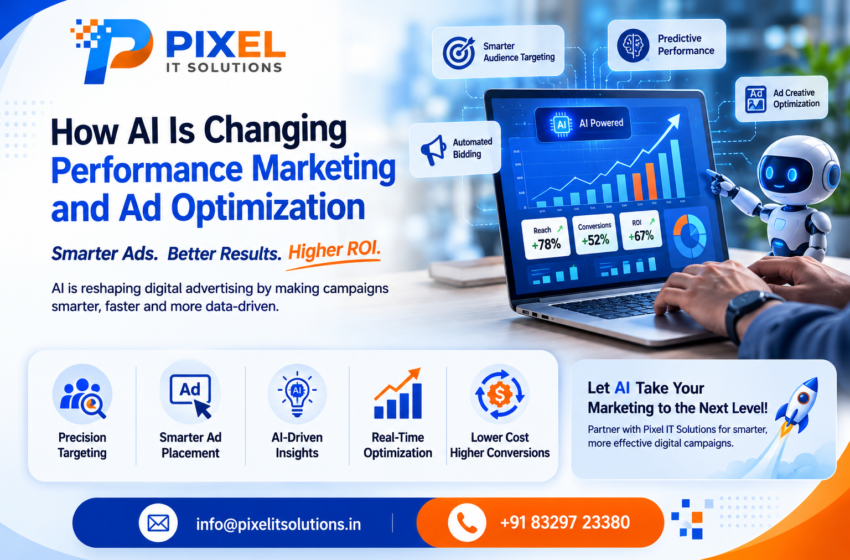
Performance marketing has always been driven by data, but Artificial Intelligence (AI) is taking data-driven advertising to the next level. Instead of relying entirely on manual campaign analysis and optimization, marketers can now use AI to process large datasets, identify patterns, predict customer behavior, personalize advertising, and optimize campaigns in real time.
For businesses, this means advertising can become more targeted, measurable, and responsive. Pixel It Solutions helps businesses understand how emerging digital technologies can support smarter marketing strategies and improve online advertising performance.
The Role of AI in Performance Marketing
AI can analyze enormous amounts of campaign data much faster than traditional manual methods. It can evaluate impressions, clicks, conversions, audience behavior, engagement, and other performance signals to identify opportunities for optimization.
This allows marketers to make more informed decisions about audiences, creatives, budgets, bidding strategies, keywords, placements, and campaign objectives.
- Smarter Audience Targeting
AI can analyze customer interactions and behavioral patterns to identify audiences that are more likely to engage or convert. Instead of targeting users only through broad demographic information, AI can consider multiple behavioral signals.
This can help marketers create more relevant audience segments and deliver advertisements to users based on their interests, actions, and likelihood of conversion. - Automated Ad Optimization
One of the biggest advantages of AI is its ability to automate repetitive optimization activities. AI-powered advertising platforms can evaluate campaign performance and adjust certain parameters based on predefined objectives.
Depending on the platform and campaign setup, AI can help optimize bidding, audience targeting, placements, budget allocation, and delivery.
This reduces the need for marketers to manually monitor every campaign adjustment. - Better Ad Creative Performance
AI is also changing the way advertising creatives are developed and tested. Marketers can use AI tools to generate variations of headlines, descriptions, images, videos, and calls to action.
Multiple creative versions can then be tested to understand which messages resonate better with specific audiences. This supports a more systematic approach to creative optimization. - Predictive Analytics
Traditional performance marketing often focuses on what has already happened. AI can help marketers move toward predictive analysis by identifying patterns in historical and real-time data.
Predictive models can support activities such as:
Identifying potential high-value customers
Forecasting campaign performance
Predicting conversion likelihood
Estimating customer behavior
Identifying potential audience segments
Supporting budget allocation decisions - Personalized Advertising
Consumers respond differently to advertisements depending on their needs, interests, and stage in the buying journey. AI can help businesses create more personalized marketing experiences by using available customer and campaign data.
For example, different audiences may receive different messaging based on their previous interactions, browsing behavior, product interests, or engagement patterns. - Faster Campaign Analysis
Analyzing multiple campaigns manually can take considerable time. AI-powered analytics can process campaign information quickly and highlight important changes or trends.
Marketers can use these insights to identify underperforming campaigns, high-performing audiences, rising costs, or opportunities for improvement.
AI vs Traditional Ad Optimization
Area Traditional Approach AI-Powered Approach
Data Analysis Primarily manual Automated and large-scale
Audience Targeting Based on predefined segments Uses behavioral and predictive signals
Bid Optimization Manual adjustments Algorithm-assisted optimization
Creative Testing Limited variations Multiple variations can be tested
Performance Monitoring Periodic reviews Continuous data analysis
Personalization Rule-based Data-driven and dynamic
Decision-Making Relies heavily on marketer analysis Combines human expertise with AI insights
Optimization Speed Relatively slower Faster and more responsive
How AI Can Improve Advertising Efficiency
AI does not simply replace marketers. Instead, it can help marketing teams spend more time on strategy, creativity, positioning, and customer understanding while technology handles large-scale data processing and repetitive optimization tasks.
For example, an advertising team can establish campaign objectives and measurement criteria while AI helps analyze performance signals and identify optimization opportunities. Human marketers can then review those recommendations and make strategic decisions.
Challenges of Using AI in Performance Marketing
Although AI provides significant opportunities, businesses should not depend on automation without proper oversight. Poor-quality data can produce poor recommendations, while excessive automation may lead to decisions that do not align with a brand’s broader objectives.
Businesses should pay attention to:
Data quality and accuracy
Customer privacy
Advertising-platform policies
Conversion tracking
Attribution limitations
Brand consistency
Human review of AI-generated content
Clear campaign objectives
The best results generally come from combining AI capabilities with human marketing expertise.
The Future of AI-Driven Advertising
AI is likely to become increasingly integrated into performance marketing platforms. From predictive audience modeling and automated bidding to creative generation and campaign analysis, marketers will have access to increasingly sophisticated optimization tools.
However, successful advertising will still depend on understanding the customer, brand, market, and business objectives. AI can process information and identify patterns, but strategic human judgment remains important.
For businesses looking to improve their digital advertising performance, adopting AI thoughtfully can create opportunities for greater efficiency, personalization, and measurable growth.
Pixel It Solutions can help businesses explore digital marketing strategies that combine technology, data, creativity, and performance-focused optimization.
Make Your Advertising Smarter with AI
Ready to improve your digital advertising strategy? Pixel It Solutions can help your business explore AI-powered performance marketing, audience targeting, campaign optimization, and data-driven advertising strategies.
Connect with Pixel It Solutions today and take your performance marketing to the next level.
Company Name: Pixel IT Solutions
Website: https://pixelitsolutions.in/
📞: +91 832-972-3380
FAQs
- How is AI changing performance marketing?
AI is changing performance marketing by automating data analysis, improving audience targeting, supporting bid optimization, personalizing advertising, generating creative variations, and helping marketers identify campaign trends faster. - Can AI optimize digital advertising campaigns automatically?
Yes. Many advertising platforms use AI and machine-learning systems to optimize areas such as bidding, audience selection, placements, and campaign delivery based on defined objectives and available performance data. - Can AI improve ad targeting?
AI can analyze behavioral, contextual, and performance signals to help identify audiences that are more likely to engage or convert, potentially making targeting more efficient. - Does AI replace performance marketers?
No. AI can automate many data-heavy and repetitive tasks, but marketers are still important for strategy, creative direction, brand positioning, customer understanding, and decision-making. - How does AI help with ad creatives?
AI can assist marketers in creating and testing different headlines, descriptions, images, videos, and calls to action. Performance data can then help identify which variations work better for particular audiences. - Is AI-based advertising suitable for small businesses?
Yes. Small businesses can use AI-powered advertising features available through digital advertising platforms to automate certain optimization tasks without maintaining large marketing teams or extensive technical infrastructure.