






Introduction
Developing high-quality software requires more than just writing code. It involves a structured process that ensures the software meets business objectives, user expectations, and quality standards. This structured approach is known as the Software Development Life Cycle (SDLC).
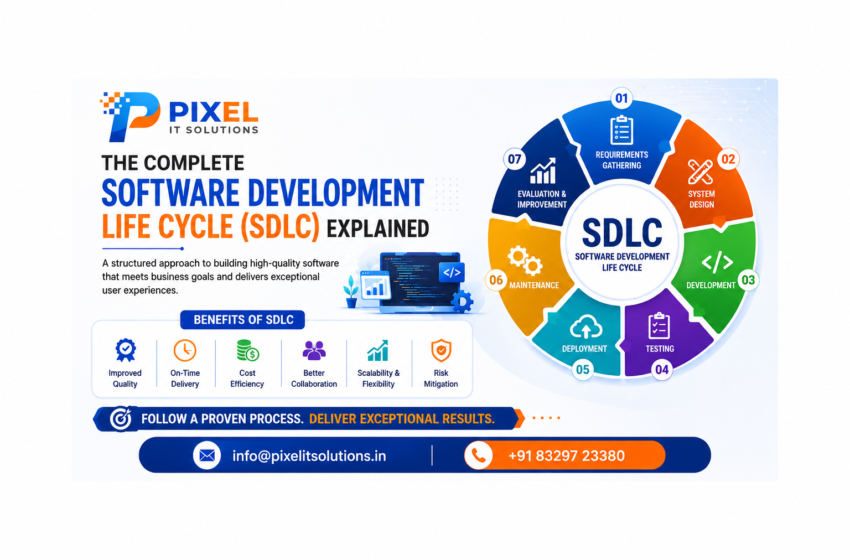
The SDLC provides a step-by-step framework for planning, designing, developing, testing, deploying, and maintaining software applications. Whether you’re building a website, mobile app, enterprise software, or cloud-based solution, following the SDLC helps reduce risks, improve collaboration, control costs, and deliver successful projects.
In this blog, we’ll explain each phase of the Software Development Life Cycle, its benefits, common SDLC models, and why businesses should adopt this proven methodology.
What Is the Software Development Life Cycle (SDLC)?
The Software Development Life Cycle (SDLC) is a systematic process used by software development teams to design, build, test, deploy, and maintain software applications. It provides a clear roadmap that ensures every stage of development is completed efficiently while maintaining quality, security, and performance. By following the SDLC, businesses can minimize errors, improve communication among teams, and deliver software that meets user and business requirements.
Why Is SDLC Important?
Implementing the SDLC helps organizations:
Deliver high-quality software
Reduce development risks
Improve project planning
Enhance collaboration between teams
Control project costs
Meet deadlines efficiently
Ensure software security
Simplify future maintenance and updates
A structured SDLC approach increases the chances of project success while reducing costly mistakes during development.
Phases of the Software Development Life Cycle
- Planning
Planning is the foundation of every successful software project. During this phase, stakeholders identify business objectives, project scope, target audience, timelines, budget, and required resources. Risk assessment and feasibility studies are also conducted to determine whether the project is technically and financially viable. - Requirements Gathering and Analysis
In this stage, developers and business analysts gather detailed functional and technical requirements from clients and end users. These requirements define what the software should do, expected features, performance expectations, and user interactions. A Software Requirement Specification (SRS) document is often created to guide the development process. - System Design
Once requirements are finalized, the design phase begins. Software architects and UI/UX designers create system architecture, database structures, workflows, wireframes, and user interface designs. This phase ensures that the software is scalable, secure, and user-friendly before development starts. - Software Development
During the development phase, programmers write the actual source code based on the approved design and requirements. Developers build front-end interfaces, back-end functionality, APIs, databases, and integrations while following coding standards and best practices. Regular code reviews help maintain quality throughout development. - Testing
Testing ensures that the software functions correctly and is free from critical bugs. QA engineers perform different types of testing, including functional testing, performance testing, security testing, usability testing, integration testing, and user acceptance testing (UAT). Identifying and fixing issues before deployment improves software reliability. - Deployment
After successful testing, the software is deployed to the production environment where users can access it. Deployment may be carried out in stages or all at once, depending on the project’s complexity. Proper deployment planning minimizes downtime and ensures a smooth launch. - Maintenance and Support
Software development doesn’t end after deployment. Continuous monitoring, bug fixes, security updates, feature enhancements, and performance optimization are essential to keep the application running efficiently. Regular maintenance ensures long-term success and customer satisfaction.
Popular SDLC Models
Waterfall Model
A linear approach where each phase is completed before moving to the next. Suitable for projects with fixed requirements.
Agile Model
An iterative methodology that delivers software in small increments, allowing continuous improvements based on user feedback.
Scrum
A popular Agile framework that divides projects into short development cycles called sprints, encouraging collaboration and rapid delivery.
Spiral Model
Focuses on risk analysis and iterative development, making it ideal for large and complex projects.
DevOps Model
Combines software development and IT operations to enable continuous integration, testing, deployment, and monitoring for faster software delivery.
Benefits of Following the SDLC
Following the Software Development Life Cycle (SDLC) provides a structured and organized approach to software development, helping businesses deliver high-quality applications efficiently. By breaking the project into clearly defined phases, SDLC improves planning, communication, and collaboration among stakeholders, developers, designers, and testers. It helps identify potential risks early, reducing costly errors and project delays. The SDLC also ensures thorough testing, resulting in secure, reliable, and user-friendly software. Additionally, it enhances documentation, making future updates, maintenance, and scalability easier. Overall, adopting the SDLC leads to better project management, improved customer satisfaction, optimized development costs, and software that aligns with business goals and user expectations.
Common Challenges in SDLC
While the Software Development Life Cycle offers numerous advantages, organizations may encounter several challenges during implementation. One common issue is changing business requirements, which can affect project scope, timelines, and budgets if not managed properly. Poor communication between stakeholders and development teams may lead to misunderstandings and incomplete requirements. Other challenges include tight deadlines, limited resources, inadequate testing, scope creep, and integration complexities with existing systems. Security vulnerabilities and insufficient documentation can also create long-term maintenance issues. Addressing these challenges requires effective project planning, continuous collaboration, regular progress reviews, and a flexible development approach that can adapt to evolving business needs.
Best Practices for Successful SDLC Implementation
Successful SDLC implementation requires careful planning, strong collaboration, and adherence to industry best practices throughout the software development process. Organizations should begin by gathering clear and detailed project requirements and involving stakeholders from the early planning stages. Choosing the right SDLC model—such as Agile, Waterfall, or DevOps—based on project complexity and business objectives is essential. Maintaining comprehensive documentation, conducting regular code reviews, and performing thorough testing at every stage help ensure software quality and reduce defects. Prioritizing security, automating repetitive tasks, using version control systems, and continuously monitoring application performance after deployment further contribute to project success. By embracing continuous improvement and incorporating user feedback, businesses can develop scalable, secure, and high-performing software that delivers long-term value.
Why Choose Pixel IT Solutions for Software Development?
At Pixel IT Solutions, we follow industry-leading SDLC practices to deliver secure, scalable, and high-performance software solutions tailored to your business needs. Our experienced developers, designers, QA engineers, and project managers collaborate throughout every phase of the software development process. From planning and design to deployment and ongoing support, we ensure your software is reliable, user-friendly, and built for long-term success.
Conclusion
The Software Development Life Cycle (SDLC) provides a structured approach to building successful software applications. By following each phase—from planning and requirements gathering to development, testing, deployment, and maintenance—businesses can reduce risks, improve quality, and deliver software that meets user expectations. Choosing the right SDLC model and partnering with an experienced development company like Pixel IT Solutions ensures efficient project execution and long-term business growth.
Build Reliable Software with Pixel IT Solutions
Looking for a trusted software development partner? Pixel IT Solutions offers end-to-end software development services, including business analysis, UI/UX design, custom software development, mobile app development, web application development, testing, deployment, and ongoing maintenance. Contact us today to transform your ideas into secure, scalable, and high-performing software solutions.
Company Name: Pixel IT Solutions
Website: https://pixelitsolutions.in/
📞: +91 832-972-3380
FAQs
- What is SDLC?
The Software Development Life Cycle (SDLC) is a structured process used to plan, design, develop, test, deploy, and maintain software applications. - Why is SDLC important?
SDLC helps improve software quality, reduce risks, manage costs, ensure timely delivery, and simplify maintenance. - What are the main phases of SDLC?
The main phases include Planning, Requirements Analysis, Design, Development, Testing, Deployment, and Maintenance. - Which SDLC model is best?
The best model depends on project requirements. Agile is ideal for evolving projects, while Waterfall works well for projects with fixed requirements. - How does testing fit into SDLC?
Testing identifies bugs, verifies functionality, improves security, and ensures the software meets quality standards before deployment. - Does SDLC apply to mobile and web applications?
Yes. SDLC is widely used for web applications, mobile apps, enterprise software, SaaS platforms, and custom software development projects.