





Search engines no longer rely on simple word-matching. Modern algorithms evaluate the underlying intent, context, and relationships between concepts to deliver exact answers. This shift makes Semantic SEO a critical requirement for sustainable organic visibility.
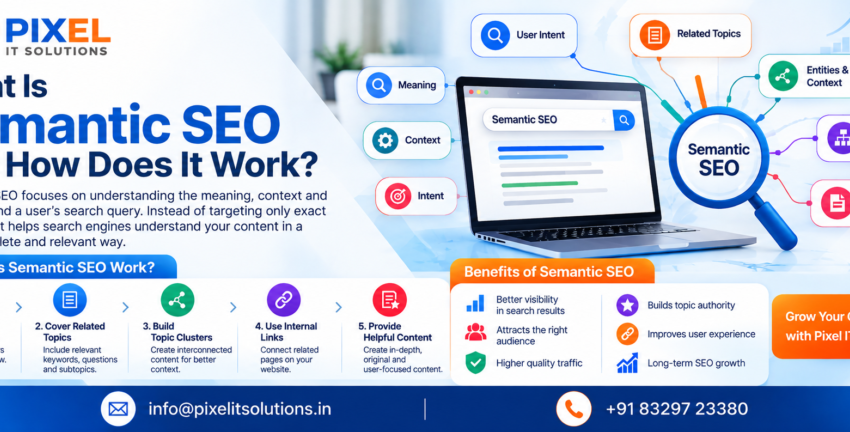
Instead of stuffing a single exact-match keyword into a post, Semantic SEO focuses on covering a topic comprehensively—addressing related entities, subtopics, and logical user questions.
What Is Semantic SEO?
Semantic SEO optimizes content around the meaning and context of a topic rather than repetitive target phrases.
For example, when writing about Website Development, you don’t need to force the exact phrase twenty times. Instead, search engines expect to see natural mentions of interconnected entities:
┌──> Front-End & Back-End Frameworks
├──> Responsive Design & Mobile UX
Web Development Context ──┼──> APIs & Databases
├──> Web Security & Performance
└──> Content Management Systems (CMS)
Including these contextual concepts naturally proves to search engines that your content offers deep expertise rather than surface-level keyword targeting.
Traditional Keyword SEO vs. Semantic SEO
Metric / Approach Traditional Keyword SEO Modern Semantic SEO
Primary Focus Exact-match keyword repetition Context, entities, and complete search intent
Content Strategy Creates thin, separate pages for keyword variations Builds comprehensive pillar pages and topic clusters
User Experience Rigidly structured around specific phrases Flows naturally to answer direct and follow-up questions
Performance Metric Ranks for a few target phrases Establishes broad topical authority across hundreds of intent queries
How Semantic SEO Works: 8 Core Pillars
- Identify Search Intent
Before writing, determine what the user actually wants to accomplish:
Informational: “How does website development work?” (Needs process guides and diagrams)
Commercial: “Website development cost in 2026” (Needs pricing breakdowns and factors)
Transactional: “Best web development agency” (Needs service details and social proof) - Map Related Topics & Entities
Identify related concepts that complete the narrative. If your primary entity is eCommerce Development, logical sub-entities include:
Payment Gateways
Shopping Carts & Checkout Optimization
Inventory Management Systems
SSL Security & Data Compliance - Build Interconnected Topic Clusters
Organize your website content hierarchy into hub-and-spoke models.
┌──> Mobile App UI/UX Design
├──> iOS vs. Android Development
Pillar Page ─┼──> Cross-Platform Frameworks (Flutter/React Native)
(Mobile App Dev) ├──> App Security Standards
└──> Deployment & App Store Optimization - Strengthen Strategic Internal Linking
Contextual links pass topical authority across your site. An article about eCommerce Web Design should link naturally to supporting resources like Payment Gateway Integration or Mobile Commerce UX. - Structure Content to Answer Direct Questions
Structure sections around high-frequency user questions:
How long does full-stack web development take?
What is the difference between custom development and CMS templates?
How do APIs connect back-end databases to front-end interfaces? - Leverage Entity Optimization
Search engines organize knowledge around Entities (people, places, platforms, technologies, and concepts). In an article about mobile app frameworks, explicitly referencing entities like JavaScript, React Native, Swift, and REST APIs clarifies your topic niche to algorithms. - Create Deep, Comprehensive Resources
Length alone does not equal quality. Comprehensive content provides immediate clarity through structured breakdowns, real-world examples, actionable checklists, and clear next steps. - Use Related Keywords Naturally
Semantic SEO does not eliminate keywords. Use variation, industry terminology, and long-tail synonyms to enrich your writing naturally without risking over-optimization penalties.
Common Semantic SEO Mistakes to Avoid
Keyword Stuffing: Inserting contextual terminology repeatedly at the expense of readability.
Ignoring Intent: Publishing a sales page when users are searching for an informational guide.
Thin Cluster Content: Publishing low-quality subtopic articles purely to gain an internal backlink.
Overlooking Internal Architecture: Leaving high-value subtopic guides unlinked from the main pillar page.
Step-by-Step Implementation Framework
[Select Core Topic] ──> [Map Intent & Entities] ──> [Build Topic Cluster] ──> [Publish & Internal Link]
Select a Core Entity: Pick an essential business service or offer (e.g., Custom Software Development).
Analyze Search Intent: Determine what questions prospective clients ask at each stage of their buying decision.
Map Out Clusters: Design a main pillar page connected to 4–6 specific subtopic guides.
Draft Comprehensive Content: Write clear, authoritative content that directly answers key questions.
Connect Internal Links: Pass authority using descriptive, natural anchor text between pillars and clusters.
Track Conversions: Monitor rankings, high-intent organic traffic, and lead inquiries.
Build a Smarter SEO Strategy With Pixel IT Solutions
Search engines prioritize websites that demonstrate comprehensive knowledge and direct solutions.
At Pixel IT Solutions, we combine technical web development, user experience design, and intent-driven semantic SEO to build digital assets that rank higher and convert qualified leads.
Transform Your SEO Strategy with Pixel IT Solutions | Call Us: +91 832-972-3380
Frequently Asked Questions
- What is Semantic SEO?
Semantic SEO is an optimization strategy focused on intent, context, and logical relationships between topics, replacing simple exact-match keyword placement. - Does Semantic SEO replace standard keyword research?
No. Keywords remain essential for identifying user demand, but Semantic SEO expands research to include related entities, synonyms, and logical follow-up questions. - What is a topic cluster?
A topic cluster consists of a comprehensive “pillar page” covering a broad subject, linked internally to multiple subtopic pages that address specific questions in detail. - How does Semantic SEO improve user experience?
By anticipating logical follow-up questions and covering topics thoroughly, users find complete solutions on your site without bouncing back to search results. - How can Pixel IT Solutions support my organic growth?
Pixel IT Solutions builds high-performance websites structured around modern semantic principles, clear content architecture, and technical SEO best practices.