


When a business has a new software idea, one of the first questions is often: “Should we build the complete product immediately?”
In most cases, the answer is no.
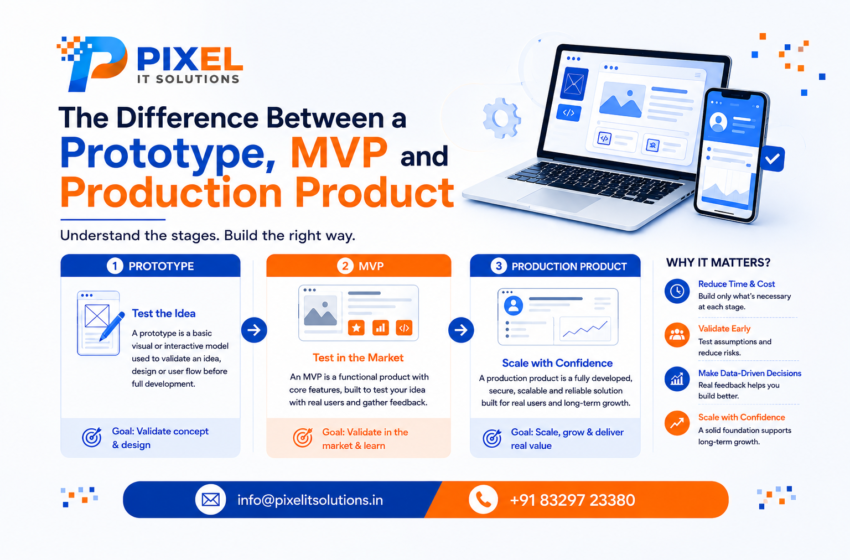
Software products usually evolve through different stages. A prototype, Minimum Viable Product (MVP) and production product each have different purposes, levels of investment and technical requirements.
Understanding the difference can help startups and established businesses avoid unnecessary development costs, validate ideas earlier and build software with a clearer roadmap.
What Is a Prototype?
A prototype is an early representation of a software product designed to demonstrate an idea or experience.
It doesn’t necessarily need to be fully functional.
A prototype can be as simple as a series of screen designs showing how users would navigate an application. It can also be an interactive model that allows stakeholders to click through a proposed user journey.
The main purpose of a prototype
The goal is to answer questions such as:
Does the idea make sense?
Is the user journey easy to understand?
Does the interface feel intuitive?
Are stakeholders aligned on the product vision?
Which features need to be changed before development?
A prototype allows businesses to discover problems before investing heavily in development.
For example, a company planning a food-delivery application could create screens for restaurant discovery, menu browsing, cart management and checkout before developing the underlying technology.
If users find the navigation confusing, the design can be changed relatively quickly.
What Is an MVP?
An MVP, or Minimum Viable Product, is a functional version of a product containing enough features to solve a specific customer problem and collect real-world feedback.
Unlike a prototype, an MVP is designed to be used by real users.
However, an MVP is not simply a smaller version of the final product.
It focuses on the minimum set of features required to test a business hypothesis.
For example
Imagine a business wants to build an online marketplace.
A complete marketplace might eventually include:
Advanced search
Seller dashboards
Buyer accounts
Reviews
Recommendations
Multiple payment options
Loyalty programs
Analytics
AI personalization
Automated notifications
An MVP might initially focus on:
User registration
Product listings
Basic search
Cart
Payment
Order management
The objective is to determine whether customers actually want and use the marketplace before investing in every planned feature.
What Is a Production Product?
A production product is the mature version of software that is designed for reliable, scalable and ongoing real-world operation.
At this stage, the product needs much more than basic functionality.
It may require:
Scalable architecture
Strong security
Performance optimization
Automated testing
Monitoring
Backup and recovery
Analytics
Error tracking
High availability
Data protection
Continuous maintenance
Integration with external systems
A production application may serve thousands or millions of users, depending on the business.
The focus shifts from simply proving that the idea works to ensuring that the product works reliably at scale.
Prototype vs MVP vs Production Product
Factor Prototype MVP Production Product
Primary purpose Validate an idea Validate the product/business model Serve customers at scale
Users Usually stakeholders/test users Early customers Real customer base
Functionality Limited or simulated Core functionality Comprehensive functionality
Development cost Low Moderate Higher
Speed Very fast Relatively fast Longer development cycle
Scalability Not usually required Limited Essential
Security Basic consideration Important Critical
Testing Design/usability testing Functional testing Comprehensive testing
Feedback Concept feedback Real-user feedback Continuous product feedback
Main goal Learn Validate Grow and operate
Why Businesses Should Not Skip the Prototype Stage
A prototype can expose problems before they become expensive development problems.
Changing a screen design is generally much easier than changing a fully developed workflow involving databases, APIs and backend systems.
Prototyping can therefore help businesses:
Reduce uncertainty
Improve user experience
Align stakeholders
Identify missing requirements
Test user journeys
Communicate ideas to developers
Reduce unnecessary development
For complex applications, this early validation can be particularly valuable.
Why an MVP Is Not a “Cheap Product”
There is a common misconception that an MVP simply means building software as cheaply as possible.
That’s not the right approach.
An effective MVP is focused, not necessarily low quality.
The product should still provide a useful experience to its intended users.
The idea is to avoid spending resources on features that haven’t yet been validated.
A good MVP answers a critical question:
Will users actually find value in this product?
Once that answer becomes clearer, the business can make better decisions about what to build next.
When Should an MVP Become a Production Product?
There is no universal timeline.
The transition depends on factors such as:
Number of users
Customer demand
Revenue
Product stability
Security requirements
Performance
Business objectives
Market feedback
Technical limitations
If an MVP begins attracting significant usage, the underlying technology may need to evolve.
For example, an MVP architecture that works well for a few hundred users may require optimization before supporting a much larger customer base.
This is where businesses need to think beyond features and consider architecture, scalability and long-term maintainability.
The Role of Technology Architecture
The difference between an MVP and production software isn’t only about the number of features.
Architecture matters.
A production-ready system may require:
Structured databases
API architecture
Authentication and authorization
Cloud infrastructure
Caching
Load management
Security controls
Automated deployment
Monitoring and logging
The right architecture depends on the product and expected growth.
Not every MVP needs enterprise-level infrastructure on day one. Overengineering an unvalidated idea can waste resources.
The goal is to build enough technical foundation for the current stage while keeping future growth in mind.
What Happens If You Build the Full Product Too Early?
Building everything before validating the core idea can create several problems.
- Higher development costs
Businesses may spend significant resources developing features that customers don’t actually need. - Longer time to market
A large feature set can delay the first opportunity to collect real customer feedback. - Greater complexity
More features create more code, dependencies, testing requirements and maintenance responsibilities. - Wrong assumptions
Internal teams may believe they understand customer needs, but actual users may behave differently. - Difficult changes
Once a product becomes technically complex, changing its fundamental workflows can become expensive.
A Better Product Development Journey
A practical product development journey can look like:
Idea → Prototype → MVP → User Feedback → Iteration → Production Product → Continuous Improvement
Each stage answers different questions.
Prototype
“Does this idea and experience make sense?”
MVP
“Will real users use this product and find value in it?”
Production Product
“Can we reliably deliver this value to customers at scale?”
This staged approach allows businesses to learn before making larger investments.
How Pixel IT Solutions Can Help
Building successful software requires more than writing code.
Businesses need to think about product strategy, user experience, technology architecture, development, testing, deployment and future scalability.
Whether you’re validating an idea with a prototype, launching an MVP or developing a production-ready application, choosing the right development approach can make a significant difference.
Pixel IT Solutions can help businesses transform software ideas into practical digital products with a structured development approach.
Have a Software Idea? Start With the Right Development Stage.
Don’t spend months building features before knowing whether your idea works. From prototype and MVP development to scalable production applications, Pixel IT Solutions can help you choose the right path and turn your concept into a reliable digital product.
Let’s build your next digital product with the right strategy, technology and roadmap.
Company Name: Pixel IT Solutions
Website: https://pixelitsolutions.in/
📞: +91 832-972-3380
FAQs
- What is the difference between a prototype and an MVP?
A prototype demonstrates an idea or user experience, while an MVP is a functional product that real users can use to validate a business concept. - Is an MVP the same as a final product?
No. An MVP contains the essential functionality needed to test the core product concept. A production product generally has greater functionality, scalability, security and operational reliability. - Can a prototype be used by real customers?
A prototype can be shown to potential users for usability testing, but it typically isn’t designed to operate as a complete customer-facing product. - Why should startups build an MVP?
An MVP allows startups to test their assumptions with real users before making a larger investment in the complete product. - Does an MVP need to be scalable?
An MVP should have an appropriate technical foundation, but it doesn’t necessarily need the same infrastructure as a large-scale production system. - When should a prototype become an MVP?
A prototype can move toward MVP development when the core user journey has been validated and the business has identified the minimum functionality required to test the product with real users. - How long does it take to build an MVP?
The timeline depends on the product’s complexity, features, integrations, technology requirements and development approach. A focused MVP generally takes less time than a full production product. - What happens after an MVP?
After launching an MVP, businesses can collect user feedback, analyze product usage, identify problems and prioritize improvements before expanding toward a more complete production product. - Can an MVP become the final product?
Yes. Some MVPs evolve directly into production products, while others require architectural improvements or redevelopment as usage and requirements grow. - Should every software project start with a prototype?
Not necessarily. Simple projects may not require a formal prototype, while complex applications with complicated user journeys can benefit significantly from early prototyping.