




Launching a Minimum Viable Product (MVP) is one of the smartest ways for startups and businesses to test an idea without investing heavily in a complete product from day one. An MVP allows you to introduce the core version of your product, gather feedback, understand customer behavior, and validate whether your idea has real market potential.
However, an MVP is not designed to remain basic forever.
Once your product gains traction, customers begin requesting new features, usage increases, and your business goals become clearer, you may reach a point where your MVP needs to evolve into a fully developed, scalable product.
The challenge is knowing when the right time to make that transition is.
Upgrading too early can waste resources on features customers may not need. Waiting too long can create performance problems, technical debt, poor user experiences, and missed growth opportunities.
Let’s explore the key signs that indicate your MVP is ready to become a full product.
What Is an MVP?
An MVP is the initial version of a digital product that includes only the essential features required to solve a specific customer problem.
The primary purpose of an MVP is not to create a perfect product. It is to:
Validate a business idea
Test product-market fit
Collect user feedback
Understand customer behavior
Reduce development risk
Test revenue potential
Identify the most valuable features
For startups, MVP development provides an opportunity to learn from real users before committing to a larger development investment.
But as the product grows, its requirements naturally change.
Why Should You Upgrade an MVP?
An MVP is built for learning and validation.
A full product is built for growth, scalability, reliability, and long-term business operations.
As your customer base grows, the limitations of an MVP can become increasingly visible. The original architecture may not support higher traffic, users may request advanced functionality, and the business may require better integrations, analytics, security, and automation.
The upgrade should therefore happen when the product has enough evidence to justify the investment.
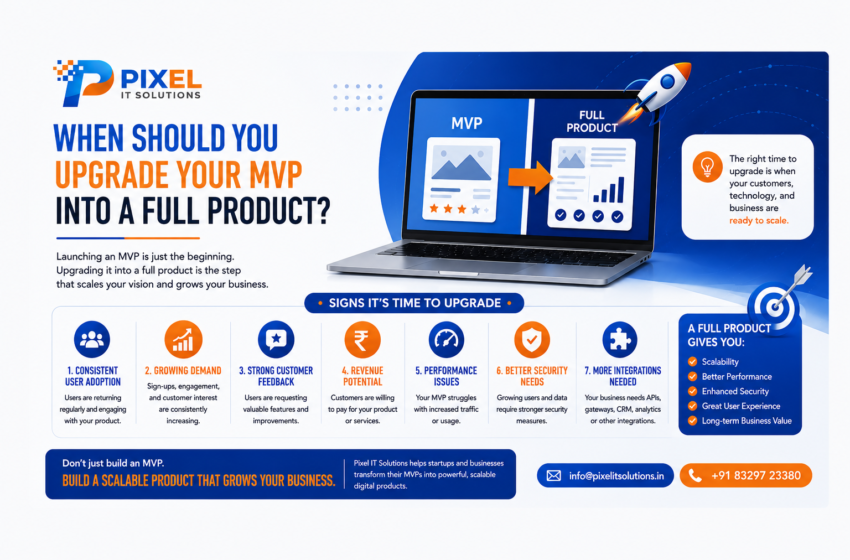
10 Signs Your MVP Is Ready for a Full Product
- You Have Consistent User Adoption
One of the strongest signals is consistent usage.
If users are repeatedly returning to your product and actively using its core features, it suggests that the MVP is solving a genuine problem.
Look for indicators such as:
Increasing active users
Strong user retention
Repeat usage
Growing sign-ups
Increasing engagement
Positive customer feedback
If customers continue using your MVP instead of abandoning it, you may have enough validation to begin investing in a more comprehensive product. - You Have Achieved Product-Market Fit
You don’t necessarily need millions of users before upgrading your MVP.
What matters is whether you have evidence that your product satisfies a real market need.
Signs of product-market fit can include:
Customers actively recommending your product
Organic customer growth
Strong retention
Customers willing to pay
Consistent demand
Positive feedback about the product’s core value
Once you understand who your customers are and why they need your product, you can make more confident development decisions. - Customers Are Requesting New Features
Customer feedback is extremely valuable during the MVP stage.
If multiple customers repeatedly request similar features, that can indicate your product is ready to evolve.
For example, customers may ask for:
Advanced dashboards
Payment integrations
User management
Mobile applications
Automated workflows
Reporting features
Third-party integrations
Advanced search
Notifications
However, don’t automatically add every requested feature.
Prioritize features based on:
Customer demand + business value + development feasibility. - Your MVP Is Struggling with Performance
An MVP may perform perfectly with a small number of users.
But as traffic grows, technical limitations can become obvious.
You may experience:
Slow loading
Server issues
Database bottlenecks
API limitations
Downtime
Poor mobile performance
Increasing error rates
These are strong signals that your technical infrastructure needs to evolve.
A full product should be designed with performance and scalability in mind. - You Are Experiencing Rapid Business Growth
Business growth can change your technology requirements.
For example, an MVP initially designed for 100 customers may struggle when you reach 10,000 customers.
As your business grows, you may need:
Scalable infrastructure
Better security
Automated processes
Advanced analytics
CRM integrations
Payment systems
Multiple user roles
Administrative dashboards
Technology should support growth rather than become a bottleneck. - Your Revenue Justifies Further Investment
Revenue is another important indicator.
If customers are paying consistently for your MVP, you have stronger evidence that the product has commercial potential.
At this stage, investing in:
Better UX
Advanced functionality
Infrastructure
Security
Automation
Integrations
Customer support tools
can help increase retention and revenue.
The goal is to make sure product development is connected to measurable business outcomes. - Your MVP Has Too Much Technical Debt
MVP development often involves making practical compromises to launch quickly.
Some shortcuts are reasonable during validation.
But over time, technical debt can become expensive.
Examples include:
Outdated frameworks
Poorly structured code
Limited testing
Hard-to-maintain architecture
Duplicate functionality
Inadequate documentation
Security weaknesses
If developers spend more time fixing the existing system than building valuable improvements, it may be time for a major technical upgrade. - You Need Better Security
Security becomes increasingly important as your user base and data volume increase.
A growing product may need:
Strong authentication
Role-based access control
Data encryption
Secure APIs
Regular security testing
Backup systems
Monitoring
Compliance controls
A basic MVP may not have been designed for enterprise-level security requirements.
If you are handling sensitive customer or business information, strengthening security should become a priority. - You Need Advanced Integrations
MVPs often operate as standalone products.
As businesses grow, they may need to connect the product with other systems.
Common integrations include:
Payment gateways
CRM platforms
Accounting software
Marketing platforms
Communication tools
Analytics platforms
ERP systems
Cloud services
External APIs
Integrations can turn a simple MVP into a much more powerful business platform. - You Have a Clear Product Roadmap
Don’t upgrade your MVP simply because it has been running for a certain amount of time.
A better approach is to upgrade when you have a clear understanding of:
Who your customers are → What they need → What features matter → How the product will generate value → How it will scale.
A well-defined roadmap makes full-product development more predictable and reduces unnecessary investment.
MVP vs. Full Product
MVP Full Product
Focuses on core functionality Offers a comprehensive feature set
Designed for validation Designed for long-term growth
Limited user base Supports larger user volumes
Basic infrastructure Scalable infrastructure
Faster development More extensive development
Lower initial investment Higher development investment
Focuses on learning Focuses on optimization and growth
The transition isn’t simply about adding more features. It involves improving the entire product ecosystem.
What Should You Upgrade First?
Once you’ve decided to move beyond the MVP, avoid rebuilding everything simultaneously.
A phased approach is usually more practical.
Phase 1: Analyze the Existing MVP
Review:
User feedback
Analytics
Technical architecture
Performance
Security
Customer behavior
Phase 2: Prioritize Features
Identify which features will have the greatest impact on:
Revenue
Customer retention
User experience
Operational efficiency
Phase 3: Strengthen the Technology
Improve:
Architecture
Database
APIs
Cloud infrastructure
Security
Performance
Phase 4: Improve UX/UI
Use customer feedback to simplify workflows and create a more intuitive experience.
Phase 5: Build and Test
Develop new functionality incrementally and test it with real users.
Phase 6: Monitor Performance
After launching improvements, track:
User engagement
Retention
Conversions
Revenue
Performance
Customer satisfaction
This creates a continuous product improvement cycle.
Should You Rebuild the MVP or Improve It?
Not every MVP requires a complete rebuild.
In some cases, the existing architecture can be upgraded gradually.
In other situations, technical limitations may make rebuilding more practical.
Consider rebuilding when:
The architecture cannot scale
The codebase is difficult to maintain
Security vulnerabilities are difficult to resolve
New features require major workarounds
Performance problems are persistent
The technology stack is no longer suitable
If the foundation is strong, however, a phased upgrade may be more cost-effective.
How Pixel IT Solutions Can Help
Moving from MVP to a full product requires more than adding features. It requires a development strategy that considers scalability, user experience, security, performance, integrations, and long-term business goals.
Pixel IT Solutions can help businesses transform validated MVP ideas into robust digital products through thoughtful product development, web application development, software solutions, UI/UX, and scalable technology implementation.
Whether you’re improving an existing MVP or planning the next stage of your digital product, the right development partner can help you turn customer feedback and business insights into a scalable product.
Conclusion
An MVP has one primary purpose: to learn whether your idea works in the real world.
Once you’ve validated the problem, attracted consistent users, demonstrated demand, and developed a clear roadmap, continuing to operate with MVP-level infrastructure may hold your business back.
The right time to upgrade is when the evidence shows that your product has real demand and meaningful growth potential.
Don’t upgrade simply because you can add more features.
Upgrade because your customers, technology, and business are ready to grow.
Is Your MVP Ready for the Next Stage?
Don’t let an MVP become a limitation when your business is ready to grow. Pixel IT Solutions can help you evaluate your existing product, prioritize improvements, strengthen its technology, and build a scalable full-product experience.
Have an MVP that you’re ready to take to the next level? Connect with Pixel IT Solutions today and turn your validated idea into a scalable digital product.
Company Name: Pixel IT Solutions
Website: https://pixelitsolutions.in/
📞: +91 832-972-3380
FAQs
- What is the difference between an MVP and a full product?
An MVP contains the essential features needed to validate a product idea, while a full product is designed for long-term users, scalability, security, performance, and broader functionality. - When should a startup move from MVP to a full product?
A startup should consider upgrading when it has consistent user adoption, strong customer feedback, commercial traction, product-market fit, and a clear roadmap for future growth. - Does an MVP need to be completely rebuilt?
Not always. If the existing architecture is scalable and maintainable, you may be able to upgrade it gradually. A rebuild may be appropriate when technical debt or architectural limitations significantly restrict growth. - How do I know if my MVP has product-market fit?
Strong retention, repeat usage, customer referrals, willingness to pay, increasing demand, and positive customer feedback can all indicate product-market fit. - What features should be added after an MVP?
Prioritize features based on customer demand and business value. Common additions include integrations, analytics, automation, advanced dashboards, user management, payment functionality, and improved security. - How much does it cost to turn an MVP into a full product?
The cost varies depending on the existing technology, number of users, features, integrations, security requirements, design requirements, and scalability needs. A technical audit and product roadmap can provide a more accurate estimate. - Can an MVP handle thousands of users?
It depends on how it was built. Some MVPs can scale effectively, while others require infrastructure, database, architecture, or performance improvements before supporting significant user growth. - Why is technical debt a problem when scaling an MVP?
Technical debt can make new development slower, increase maintenance costs, create performance issues, and make future changes more difficult.